29 March 2011

Quinoa With Zucchini, Pancetta & Tomatoes


I am unfamiliar with quinoa (pronounced Keen-wah) but had been seeing it quite a lot lately in the internet that I had to venture on my own too to find out about this seemingly healthy pseudocereal that's high in protein.  It is not available in the regular supermarkets so I found it in a gourmet shop with food from across the globe in the next town.  My quinoa box traveled all the way from Bolivia. 

Quinoa originated in the Andean region of South America some 5,200 to 7,000 years ago but was not domesticated until 3,000 to 4,000 years ago.  The Incas considered it sacred and in their tradition, it was the emperor who sowed the seeds of the season with a gold shovel.   When the Spanish arrived, they suppressed the cultivation of quinoa due to its association with non-Christian ceremonies.   In its place, wheat was grown.

They are the seeds of the Chenopodium or goosefoot plant.   In their natural state, they are covered with saponin, a bitter & unpalatable coating.  When they are commercially packed, they are usually rinsed to send the saponin away but it is always better to give it a cursory rewashing at home before cooking. 

Still in the introductory stage, I opted for a safe & dependable alternative to cook it.  You never fail making a dish flavorful with pancetta affumicata (smoked pancetta), zucchini and tomatoes.  Aside from that, I want to lure my kids into eating it so these ingredients are a safe bet. 


 Quinoa With Zucchini, Pancetta & Tomatoes

Ingredients:
Serves 4
  • 120 g. quinoa, rinsed
  • 3 medium zucchini, cubed
  • 4 cherry tomatoes, quartered
  • 110 g. pancetta affumicata (smoked pancetta)
  • salt & pepper
  • extra virgin olive oil
  • 1/2 cup water 
    1. In a pot, boil about 300 ml. water for cooking the quinoa.  Add salt.  Pour quinoa in boiling water and cook for 12 to 15 minutes or until the seeds open.  Drain.  Set aside. 
    2. While boiling the water for the quinoa, pour some oil in a saucepan and mix with half a cup of water.  With the water & oil still tepid, add the chopped zucchini.  Cook until the water completely evaporates and the zucchini start to sizzle and brown.  This should take about 20 minutes or so.  Stir once in a while to avoid sticking to the pan & burning.
    3. Add the pancetta.  Cook until they start to look toasted. Add the tomatoes and cook for about 5 minutes.   Season with salt & pepper.
    4. Add cooked quinoa.  Mix well.  Drizzle with extra virgin olive oil.

    Pin It

    Pea & Veal Risotto


    After a hectic weekend of children's parties & picnics, a hiatus from cooking would have been a treat.  I was just thinking of preparing a simple pasta of parmigiano reggiano (Italian parmesan cheese) & extra virgin olive oil that both my kids love, but my one-year old slept before lunch.  When she dozes off at that time, I usually savour the tranquil in the kitchen and enjoy whipping up something without being rushed by hungry kids.  I was deliberating whether to stick to my original plan and relax while she's sleeping or devote the only quiet time of the day tiring myself out in the kitchen.  I was delirious.  I chose the latter.   It's because I opened the refrigerator.  When I do that, I get stuck.  I quickly scanned what contents are in dire need to be eliminated.  Nothing.  In the freezer, my eyes landed on a piece of recently frozen emergency veal fillet that I had been saving for my one-year old in case I cook something she cannot eat.  Then I saw a package of frozen peas.   The prospect of getting that rest is shelved.

    I put together a risotto of veal & green peas minus the white wine & butter that usually go with the risotti.  I was intending to cook an Asian dish by cooking the veal & green peas together with some soy sauce then boil the rice separately.   At the last minute, the wind changed its course and I did a risotto instead.  I didn't find anything similar in any Italian site so that impelled me more to experiment.  I thought it was unusual because peas and meat are normally cooked together.   Apparently, not in risotti.

    I was more than happy with the result.  The parmigiano reggiano (Italian parmesan cheese) gave it a rounder taste.  The final verdict though will be given by my two little critics.  I waited for any dissents, shoving of the dishes away or any little squeaking that can signify a lament.  Silence.  Then "gnam-gnam" followed by "buona"!  Whew!  I got you kids! 


    Pea & Veal Risotto

    Ingredients:
    Serves 2
    • 40 g. veal, ground
    • 1/2 cup frozen green peas
    • 1/8 onion, chopped finely
    • 1/2 cup rice
    • 2 spoons parmigiano reggiano (Italian parmesan cheese), grated
    • 1 to 1 1/2 cups hot vegetable broth
    • extra virgin olive oil
    • salt
    1. Saute' onions in a small pot.   Add veal & green peas.  Cook until meat changes color, about 8 - 10 minutes. 
    2. Add rice.  Toast for about 5 minutes.
    3. Add broth little by little.  Keep on moving risotto on low fire.  Keep on adding the broth until you reach the desired consistency.   Season with salt if needed.
    4. When risotto is cooked, turn off fire, add parmigiano reggiano & drizzle with extra virgin olive oil.

      Pin It

      27 March 2011

      Linguine al Nero di Seppia (Cuttlefish Black Ink)


      Linguine al nero di seppia, the pasta that takes out the ugly part of everyone.  While eating this, we couldn't decide who was the ugliest.  With our mouths & teeth completely blackened, it was horrifying for our one-year old to be on the same table with us.  She couldn't decide whether to cry or laugh along with our poor attempts to make fun of each other.  The poor kid was petrified that her whole family turned into black-mouthed sinister looking characters.

      You almost don't find this pasta in the restaurants.  I did only once but instead of the classic linguine that goes with it, they mixed it with a kind of short pasta and they also give you a gigantic bib so that you don't dirty your shirt.   It's really the dish that you should never eat with someone you are trying to impress.  Or actually, the dish that you should eat when you want to ward off someone. 


      This pasta is a must-try but can be quite a nuisance when preparing and eating because of the black ink.  I cleaned the cuttlefish on my own on one or two occasions but I swore I won't clean them again.   I broke the ink sacs and I made a black mess.  Now our fishmongers do it.  If you have to clean them on your own, don't forget to wear disposable gloves and a big apron to cover your clothes.  The ink stays in the fingers for some time even after washing frequently.

      In case you find yourself without the ink, like what happened to me already, don't worry.  Continue cooking without the ink.  It will still come out delicious.  Nowadays, in Italy, you can buy the cuttlefish ink in commercially packed little packages.  I usually have one in the refrigerator for emergency cases when I accidentally throw the fresh ink sacs or the fishmonger forgets to include them with the cleaned cuttlefish.


      Linguine al Nero di Seppia (Cuttlefish Black Ink)

      Ingredients:
      Serves 4
      • 350 - 400 g. linguine
      • 500 g. medium cuttlefish, cleaned & diced
      • ink sacs of the cuttlefish
      • 500 g. cherry tomatoes, quartered
      • bunch of parsley, chopped finely
      • 3 - 4 cloves garlic, halved
      • salt & pepper
      • 1 chili
      • 1 cup white wine
      • extra virgin olive oil

      1. Boil water for the pasta.  When the water boils, add salt then the pasta.  Follow what is written in the packet for the number of minutes you should cook them.  Just remember that the sauce should cook ahead of the pasta, not the other way around. 
      2. Saute' garlic & chili in a saucepan with extra virgin olive oil.   When they turn golden, discard.  Add diced cuttlefish.  Cook on medium flame until liquid is is reduced by half. 
      3.   Add white wine.  Let evaporate on high flame until alcohol evaporates.  Put back to medium and add quartered tomatoes.  Cook for about 15 minutes.  Season with salt & pepper.  Add the parsley, leaving some for later.   If the sauce becomes too dry, add some water from the pot you are boiling for the pasta.

      4.   Pierce the ink sacs with a paring knife on top of the saucepan, making the contents fall in the sauce.  Discard the sacs when empty.   Stir.  Cook for another 5 minutes.  Add the remaining parsley.  Add the cooked pasta.  Mix well.  Turn off the fire and drizzle with extra virgin olive oil before serving.
      Pin It

      26 March 2011

      The Porchetta of Ariccia


      When you think of Ariccia, you think of porchetta and viceversa.   In fact, that's exactly what crossed my mind when I thought of visiting the town.  Porchetta is the iconic traditional pork specialty of central Italy, especially the towns of Ariccia of the region of Lazio and Norcia of the Umbrian region.  It's a savoury roasted whole pork, deboned, and stuffed with an abundance of salt, aromatic herbs, garlic & pepper.  It can be eaten as a main dish or served in a panino or sandwich.  All over central Italy, you can find white food vans selling porchetta.  

      I love porchetta when there are cracklings, some fat around the meat & a shameless amount of cholesterol in it.  I can't help it because try as I might, I can't eat the lean part.  It tastes too dry.  I eat it like a main dish, slightly warm & sometimes drizzled with balsamic vinegar.  Or I eat it in a panino.  Either way, it is divine.  

      Ariccia is a nice, quiet town that's just about 30 kilometers from Rome.  It is located in the Alban Hills and is among the towns of Castelli Romani.  It had a strong significance to the Ancient Roman history particularly because of its ties with the goddess Diana.  The earliest findings prove that the city had existed in 8th to 9th century B.C. 


      Pin It

      25 March 2011

      MyCityCuisine - A Wiki Project

      I was recently contacted by Mycitycuisine to help look for contributors for their project.  It speaks about the traditional foods from different cities and countries all over the globe.  It's a fundamental source of gastronomical information that every traveler needs. 

      My connotation of traveling is exploring the sights & local kitchen of my destination.  Getting information about the sights is fast & easy but acquiring basic knowledge about what culinary treats a place has to offer entails too much time searching for food suggestions at myriad sites, wondering if they are even reliable.  Mycitycuisine solves all these with one click.

      So if you have something to contribute about a local gastronomy, wherever that might be, join in and make this project grow.  Find out how and share your knowledge.

      "MyCityCuisine is a wiki project. Its goal is to help travelers discover the local food from around the world. Food has always been an integral part of the local culture so, naturally, tasting local food is often high on most traveler's to-do lists. However, until now, there was no single comprehensive source providing this particular information for cities around the world.
      "What should I order?", an inevitable question faced by all travelers sitting in a restaurant, in a foreign country. MyCityCuisine is a project to create a free, reliable and up-to-date guide to the most original and tasty local foods from different countries of the world. This is an open project, so we encourage everyone to contribute to it."
      Pin It

      24 March 2011

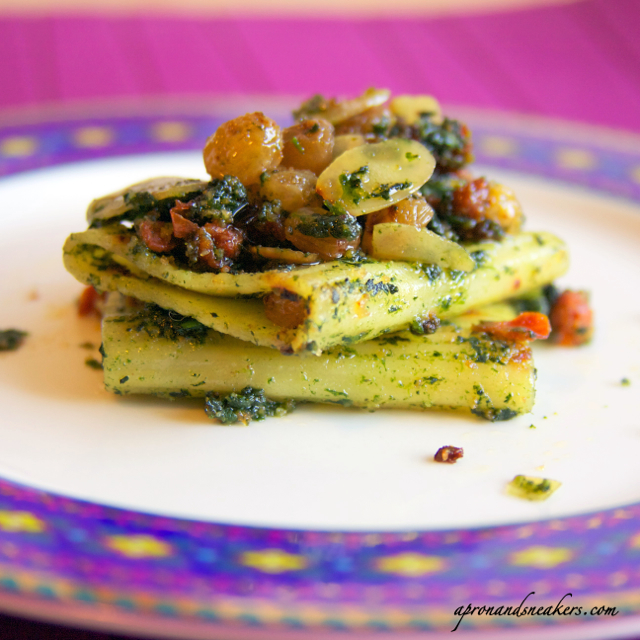
      Mezze Maniche Giganti With Spinach, Raisins, Almonds & Sundried Tomatoes


      When I mix too many ingredients together, it can mean that I am running out of creative juices.  My main objective in this recipe is to deplete the new big bag of spinach that has sprouted in my refrigerator.  My husband has been taking home colossal packages of greens lately.  And with those packages, he bequeaths to me the problem of cooking them all up within a couple of days.  It's not easy when you have two kids who have an aversion to eating leftovers.  Even if they loved the food I served in one meal, they will instantly give a duad of whines & complaints when they see a repeat.

      With the spinach, I was able to extract the other ingredients in my cupboard & refrigerator.   This pasta has a southern Italian flavour that is explosive in contrasting tastes. 


      Mezze Maniche Giganti With Spinach, Raisins, Almonds & Sundried Tomatoes

      Ingredients:
      Serves 4
      • 400 g. mezze maniche giganti pasta or any short pasta
      • 300 g. spinach
      • 1 cup raisins, soaked in water, drained & patted dry
      • 6 sundried tomatoes, chopped
      • 2 cloves garlic, halved
      • 3 - 4 fillets salted anchovies
      • 1/2 cup almonds, shaved
      • 6 tablespoons breadcrumbs
      • extra virgin olive oil
      • salt & pepper
      • 1 chili
      1. Boil water for the pasta.  Cook pasta according to packet's instructions. 
      2. Saute' garlic & chili in a non-stick saucepan with extra virgin olive oil.   When they change color, add the anchovies.  When they start to diffuse, add the spinach.  Cook for about 20 minutes.  Discard garlic & chili.  Transfer to a food processor to chop.  Set aside. 
        3.   Using a kitchen paper towel, wipe off remaining oil from the saucepan you used for cooking the   spinach.  Toast the breadcrumbs, shaved almonds, sundried tomatoes & raisins for about 5 minutes.  Transfer to a bowl & set aside.

            4.   Still in the same saucepan with low flame, put the chopped spinach.  Add the cooked pasta and mix well.  Add the breadcrumb mixture.  Mix well.  Turn off fire.  Drizzle with extra virgin olive oil before serving.


              Pin It

              23 March 2011

              Prosecco & Creme de Cassis Poached Pears With Lavender


              After using the lavender flowers with the strawberry risotto, I was totally stimulated in using them again for another dish.   I wanted something sweet this time.  My eyes landed on my kids' remaining pears in the kitchen fruit bowl.  They are their fruit of the moment & the only kind they recognize apart from the occasional strawberries that we buy.   Conscience-smitten but continuing on because of curiousity, I checked around the internet if my idea was plausible.  There are some recipes already floating around and I found one that caught my interest in La Buena Vida.  The pears are poached in prosecco instead of the usual water.  Gathering my ingredients, I happened upon a bottle of Creme de Cassis, a remnant of my last forage of something special while in France.  It is a dark red liqueur made from blackcurrants.  Mainly used for the French cocktail kir, it seemed to be a good candidate to replace the juice the recipe was asking for.   I did some modificatons to the recipe that I found fitting as to how I want the pears cooked. 


              It is ambrosial, worthy of all positive adjectives.   It's reminiscent of the preserved peaches that was cooked in white wine that we bought once from a small local producer of a town we visited.  Only these pears have a more intense taste that the Creme de Cassis induced.  My kids tried it and left me with just bits to relish.  They practically polished off the whole plate!   I did another batch that night with enough pears for the whole family to enjoy.  This is really worthy of your time & effort.  If you cannot find the Creme de Cassis, substitute it with blackcurrant or raspberry syrup. 

              Leaving the pears whole, just peeled, is more appealing.  In fact, that's how most people poach their pears.  I would like to do that too but I have the need to see what is in store for me inside the fruit. I don't like seeing nature's surprises after I cook the pears.  They're less beautiful but at least I have the peace of mind that there are no other living things inside them.

              The next time I do this recipe, I will do more to bottle & preserve.  Just cook the liquid less to maintain a watery syrup and bottle the pears with it.


              Prosecco & Creme de Cassis Poached Pears With Lavender

              Ingredients:
              Serves 2
              • 2 big pears or 4 small pears, halved lengthwise, cored & peeled
              • 3 tablespoons sugar
              • 2 cups prosecco
              • 1/2 cup creme de cassis (can be substituted with blackcurrant or raspberry syrup)
              • a bunch of lavender
              1. Peel & core pears but don't remove the stem.  
              2. In a medium saucepan, pour the prosecco.  When it starts to boil, add the sugar & Creme de Cassis.  Simmer.
              3. Add the pears by placing them flat on the saucepan, submerged in the liquid.  Cook for about 5 minutes then add the fresh lavender leaving about a couple for later.  
              4. Cook until pears are tender.  You can check by piercing them with a sharp knife.  
              5. Take away the pears and place them on the serving plates.  
              6. Add the remaining lavender in the liquid and cook it longer until it becomes thick.  
              7. Pour on top of the pears. 


              Pin It

              Strawberry & Lavender Risotto


              Immediately after trying the wild strawberry & basil risotto, I had the urge to do this classic strawberry risotto.  I added a twist of lavender flowers seeing that my plants are full of novel flowering buds.   Cooking the two main ingredients together created an intoxicatingly wonderful scent of spring in the kitchen.  It made me yearn for the warmth much more than ever.


              Its delicacy made it very different from its offshoot wild strawberry & basil risotto.  Both were good, but having two similar dishes, we couldn't help choosing one from the other.  My husband prefers the wild strawberry for its intensity while I favour this abated version.  Perhaps it is the blending with the lavender that attracts me to this risotto.  My 5-year old refused both dishes because I think his taste buds were completely confused about the saltiness of the dish instead of the expected sweetness of the strawberries.   Without any surprise, my 1-year old ate both with her usual enthusiasm in eating.


              Strawberry & Lavender Risotto

              Ingredients:
              Serves 4
              • 250 g. Arborio rice
              • 200 g. strawberries, chopped
              • handful of lavender flowers, chopped
              • 1/4 onion, finely chopped
              • 1 liter vegetable broth
              • knob of butter
              • 1 glass white wine
              • salt
              • 1 teaspoon sugar (optional)
              • extra virgin olive oil
              1. Prepare the vegetable broth with 1 liter of water in a pot for later use.
              2. Saute' onions in a saucepan with extra virgin olive oil on medium heat.  When it starts to change color after about a couple of minutes, add the rice.  Keep moving them to avoid burning.  
              3. When the rice is toasted enough, about 3 minutes, add the wine.  Keep on moving the rice while letting the alcohol evaporate.  
              4. On low heat, add about 1/4 of the hot vegetable broth.  Continue ladling the rest of the hot vegetable broth to the risotto until you attain the right consistency.  Stir constantly. 
              5. In the middle of cooking the rice, add the strawberries & lavender.  Adjust the taste with salt.  If it is a bit acidic, adjust the taste with sugar. 
              6. When the risotto is cooked, turn of fire and add a knob of butter. 

              Pin It

              Wild Strawbery & Basil Risotto After a Trip to Nemi


              The weather is warmer, the sun is always shining and no one has been sniffling for a week now.  Our  winter hibernation is coming to an end.  The prospect of seeing the town of Nemi pulled us out of our torpidness.  It is about 40 kilometers away from Rome and overlooks Lake Nemi, a volcanic crater lake.

              There are two reasons why I earmarked this small town for a visit.  Its museum houses the remnants of the two large ships dating back from the period A.D. 37 to A.D. 41 during Roman Emperor Caligula's reign.  Another reason was to try their fragoline or wild strawberries.   Being grown on the sides of the volcanic crater, a microclimate is created by retaining the warmth of the sun, thus making the flavour more intense than the commercially grown ones.

              It's not really the period of the wild strawberries yet, with June still a bit far but we already found some shops selling them.  Our 5-year old is the one who enjoyed the sight of these acutely bright red fruit.  When he was younger, at the age of 17-months, he was already a little expert in picking his own wild strawberries in the Dolomites.   He didn't have to insist to take home some because I was also excited to try out the celebrated wild strawberries of this town.

              For the major part, I prepared the wild strawberries sprinkled with sugar while I set aside a portion for a risotto that I had in mind.   It's an offshoot of the classic risotto with regular strawberries.  Risotto with wild strawberries mixed with basil came out a tad unfamiliar to the palate but delicious nonetheless.  


              Wild Strawberry & Basil Risotto

              Ingredients:
              Serves 4
              • 250 g. Arborio rice
              • 150 g. wild strawberries
              • handful basil leaves
              • 1/4 onion, finely chopped
              • 1 liter vegetable broth
              • knob of butter
              • 1 glass white wine
              • salt
              • 1 teaspoon sugar (optional)
              • extra virgin olive oil
              1. Prepare the vegetable broth with 1 liter of water in a pot for later use.
              2. Saute' onions in a saucepan with extra virgin olive oil on medium heat.  When it starts to change color after about a couple of minutes, add the rice.  Keep moving them to avoid burning.  
              3. When the rice is toasted enough, about 3 minutes, add the wine.  Keep on moving the rice while letting the alcohol evaporate.  
              4. On low heat, add about 1/4 of the hot vegetable broth.  Continue ladling the rest of the hot vegetable broth to the risotto until you attain the right consistency.  Stir constantly. 
              5. In the middle of cooking the rice, add the wild strawberries.  When it is almost cooked, add chopped basil.  Adjust the taste with salt.  If it is a bit acidic, adjust the taste with sugar. 
              6. When the risotto is cooked, turn of fire and add a knob of butter. 


              Pin It

              22 March 2011

              Strozzapreti With Prawns & Asparagus


              I like my pasta cooked al dente and strozzapreti is a kind that never fails to maintain the firmness I look for.  For that reason, I can be quite strict in following the number of minutes in cooking any kind of pasta.  One of my indispensable companions in cooking pasta is the timer.  To be truthful, I find it irksome to keep on checking the pasta every minute to check if they're already cooked or not because I burn either my fingers or my tongue. 

              Coming to Italy, I had to reprogram my pasta cooking procedures completely from the initial to the final phase.  Apparently, there is a different world behind these seemingly simple food.   As a general rule, pasta dishes should be served immediately, as soon as they are taken out from the pan, except for the cold pastas that are served in summer.  

              On the very first dinner that my husband and I hosted when we moved in to our new house, I was turbulent.  I didn't know how to time the innumerable courses, five in all, most especially the pasta which has to be freshly cooked when served.  I learned to start boiling the water about 20 minutes before you expect the guests to arrive.  While you are having the appetizer, the water should already be boiling and the pasta cooking if it takes around 10 minutes to cook.   You should cook the sauce much ahead like the rest of the courses if you don't want to smell like dinner when you eat with your guests.  You almost always drizzle your pasta with extra virgin olive oil before serving.  Even my kids remind me to put fresh oil in their pasta before they eat.  Yes, even one-year old kids can pick up the habit fast.

              There are some things that unsettle Italians when they see tourists eat their pasta.   If you want your Italian dinner mates to relax while eating with you, just remember these two basic rules:  Do not eat your pasta with bread.   From where I came from, pasta is served with bread, like in most parts of the world I guess.   In my first experience of an authentic dinner in a restaurant, I was incredulous why the waiter took away the bread basket after we had the appetizer and put a new one after I finished the pasta and about to start the next course.  Ironically, it's the only course when you don't eat the bread.  Second rule is, do not cut your pasta please.  There are exceptions though.  You can cut the big filled-up pastas like lasagnas, raviolis & cannellonis.  While out with my husband and some friends once, there was a tourist who was cutting his spaghetti to bits before eating it.  Our friends couldn't help gaping at the clueless diner and I can almost sense them twitching every time the knife was touching the spaghetti.   No one will twitch though if the recipient of the spaghetti cutting operation is 5 years-old and below. 

              The combination of prawns, asparagus and tomatoes is divine.  Whenever I have prawns & asparagus at the same time, they always end up together in this pasta dish. 


              Strozzapreti With Shrimps & Asparagus

              Ingredients:
              Serves 2
              • 200 g. strozzapreti (100 g. per person for an abundant plate each)
              • 100 g. cherry tomatoes, quartered
              • 250 g. asparagus
              • 6 big prawns
              • 2 cloves garlic, halved
              • cognac
              • 1 cup water
              • extra virgin olive oil
              • salt & pepper
              1. Start by boiling the water for the pasta.
              2. Prepare the asparagus.  Cut them in half.  Discard the lower half.  Cut the remaining upper half again in the middle.  Set the tips aside.  Chop the remaining half in an electric chopper or mince manually.  Set aside.  
              3. Prepare the prawns.  Take them out of their shells.  Save the heads and set aside.  Devein.  Quarter them.  Set aside.  
              4. Start cooking the sauce.   In a saucepan, saute' the garlic in extra virgin olive oil for a couple of minutes.  Add the heads of the prawns and press them lightly with the ladle to make the juices come out.  Cook for about 5 minutes.  
              5. Add the asparagus tips, minced asparagus and tomatoes.  Cook for about 2 minutes then add water.  Simmer until the water is reduced by half.  
              6. Add a dash of cognac with a high flame until the alcohol evaporates.  Put back to medium flame.  Season with salt & pepper.  
              7.  Discard the garlic & prawn heads.
              8. When the sauce starts to thicken, mix in the cooked strozzapreti and toss them together for about a minute.  Turn off fire.  Drizzle with extra virgin olive oil.
              Pin It