
Orange Salad With Fennel, Celery and Colatura di Alici di Cetara (Fish Sauce)
I'm crazy about orange salads and I think I combined my oranges with everything imaginable. Orange season is the part of winter that I look forward to the most. Happy orange person that I am with an equally orangey wooden board. With the festivities going on this weekend, I was able to squeeze in a trip to the commercial center to go wooden board and paint shopping with a little Zorro and fairy princess tagging along and arguing about which shade of orange is better. The fairy princess was trying to make me disappear with a wave of her wand because of my continual habit of saying, "Basta!" (Stop it!). Then on to our companionable Zorro to zap him and leave her in peace with her preferred shade of orange. That was my weekend with the fairy princess and little Zorro and other walking Nemos, dynamites, clowns, jellyfish, the whole cast of Star Wars, a congregation of super heroes, princesses of all colors and anything imaginable walking freely around. How was yours?

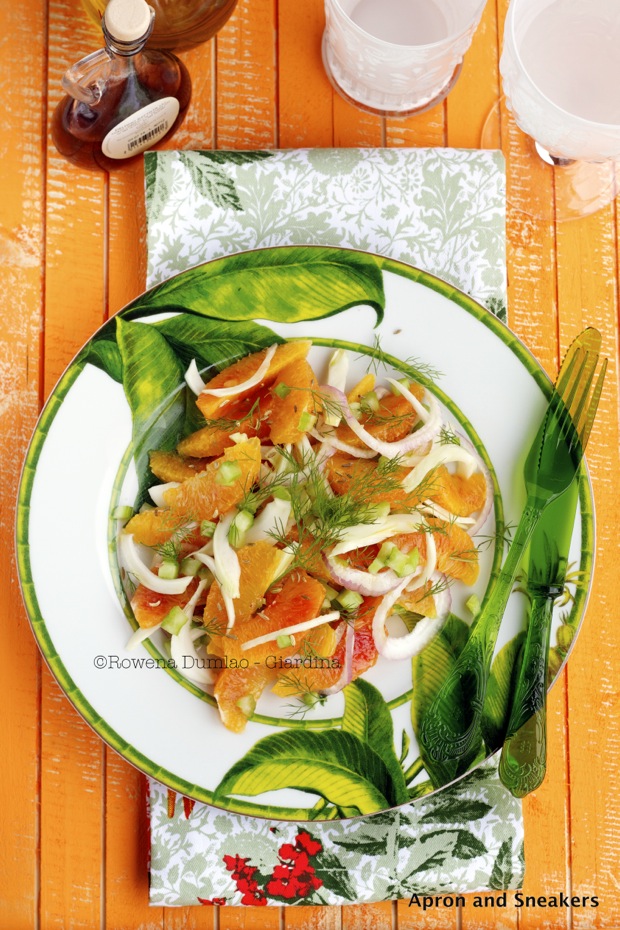
I have here a very simple salad using Tarocco oranges, a kind of blood orange that I mixed with chopped celery, Tropea red onion, a very mild red onion from the town of Tropea in the region of Calabria, Italy and a bulb of fennel then dressed with extra virgin olive oil and colatura di alici di Cetara, the Italian anchovy sauce from the small fishing village of Cetara in the Amalfi Coast of Italy. I know, the simple orange salad I mentioned had grown into something complicated with the origin and variety of ingredients I used.

I'll tell you a little bit about the orange, the onion and the fish sauce.
Tarocco orange is one of the 3 most popular blood orange varieties in Italy, the other two being Moro and Sanguinello. All three of these Arance Rosse di Sicilia (Sicilian blood oranges) are grown in Eastern Sicily and have been designated the Protected Geographical Indication (PGI) by the European Union. The most available blood orange is the Tarocco variety. It's referred to as "half-blood" because it is only partially tinted with red or anthocyanin (antioxidant) on the skin and flesh unlike the other two kinds. What makes it very good is its sweetness. In fact, it's the variety I love using for spremuta d'arancia (freshly squeezed orange juice) and salads.
The Cipolla rossa di Tropea (Tropea red onion) is another one designated the Protected Geographical Indication (PGI) by the European Union. What makes this onion special is its sweetness and very low lacrimal factor (the one that makes you cry) and its easiness in digestibility. It is grown at some particular areas of Calabria that are close to the coastal town of Tropea. They have been grown in other parts of the country and the world but nothing comes close to the special taste of the ones grown directly from the soil of Tropea.
The colatura di alici di Cetara (fish sauce of Cetara) is the most interesting one among the three. It has a great similarity to the ancient Roman's garum, a
kind of sauce from fermented fish intestines. The anchovies used in
making the modern day colatura are caught in the waters of the Amalfi
Coast between the 25th of March, the Feast of Annunciation until the
22nd of July, the Feast of St. Mary Magdalene. Since the ancient Romans
had been keeping recipes during their time, the recipe for garum was
recuperated by monastic groups staying at the Amalfi Coast in the Middle
Ages. The production scattered along the coast until it was perfected
and it is the method used in producing the sauce now in Cetara.
The
heads and entrails of the freshly-caught anchovies are removed then the
fish are stored in containers with sea salt for 24 hours. They are
then transferred inside small oak or chestnut barrels alternating with salt
and weights. Because of these weights, the anchovy liquid goes on top
and it is then transferred to large glass containers that are exposed to
direct sunlight for 4 - 5 months. Because of water evaporation, the
liquid becomes more concentrated. The anchovies that remained in the barrels are the ones sold as bottled anchovies. The liquid is then transferred back
to wooden barrels with anchovies at the end of October and beginning of
November. The liquid goes through the anchovies to gain more flavor
then it goes out through a hole in the barrel and it is filtered with linen cloths and bottled for consumption at the
beginning of December. (Information taken and translated from Wikipedia.)

The colatura di alici is compared to the Asian fish sauce. In fact, I grew up using Asian fish sauce so when I found out about the colatura di alici, I immediately embarked in looking for it. I got my first bottle after a couple of years of looking for it because I didn't know the name or where in Italy it was produced. I had to explain the process of producing it everytime I looked for it in a shop. The first time I bought a bottle, I remember being shocked about the price. For such a tiny bottle, I had to pay 10 times more compared to a big bottle of Asian fish sauce. The similarity is there, in fact, maybe if I didn't grow up with the Asian fish sauce, I would say that they are the same. The colatura di alici is richer, smoother and rounder in taste and smell. I don't buy anymore the Asian counterpart and use the colatura in all my Asian dishes. The taste is almost the same unless you pay particular attention to what you are tasting. The colatura di alici should be close to impossible to find outside Italy but I think you can find them online. Replace with its Asian counterpart if you really can't find it.

I hope you learned something like I did. It took a bit of more research than my usual and I hope it had been educational for you as much as it had been for me. I prepared a cake for this Valentine's post but I pulled it out at the last minute because it was not as perfect as I would have wanted it to be. You know me, not really the greatest baker in the world. So here is my Valentine's post of an orange salad. I hope you forgive me.
Happy Valentine's Day!


Orange Salad With Fennel, Celery and Colatura di Alici di Cetara (Fish Sauce)
Ingredients:
Serves 2
- 4 oranges, wedges
- 1/2 mild red onion (I used a Tropea onion.), sliced to rings
- 2 stalks celery, roughly chopped
- 1 bulb fennel, roughly chopped
- 2 tablespoons colatura di alici di Cetara (replace with Asian fish sauce if not available)
- extra virgin olive oil
- freshly cracked black pepper
- Mix all dry ingredients together in a plate.
- Dress with fish sauce, extra virgin olive oil and pepper before eating.

