Potato skins are good for you. That was a first for my husband and armed with the new knowledge, he went home still disbelieving what he just heard and confirmed at the internet. God, I hope so. I had been eating potato skins half of my life. They actually taste good. If only I can remember how they were cooked when I used to eat them. With melted cheese perhaps, because I remember accompanying them with a cold bottle of beer.
Pin It
30 April 2011
29 April 2011
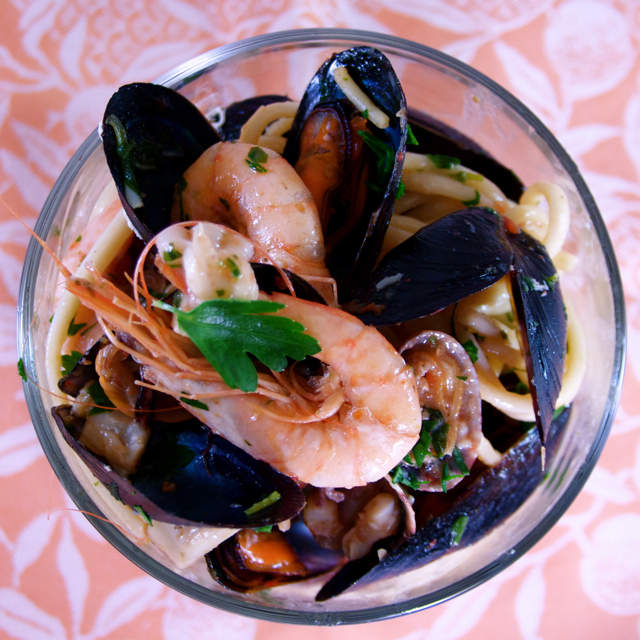
Linguine alla Pescatora
After an endless amount of meat during the Easter holiday, I was screaming seafood. It was beckoning to me. Living in a seaside town of Rome, I get to have a choice of the freshly caught aquatic marvels.
On sunny weekends, whatever season it may be, throngs of people arrive in our town that it can become excessive at times. We, on the other hand, go to the opposite direction looking for greener pasture, more inland, and I imagine questioning looks darted at us leaving the beach on such a beautiful day.
26 April 2011
San Gemini
San Gemini is an Umbrian medieval village with well-maintained alleys, arches & staircases. If devoid of cars or passers-by, you would have an unsettling feeling that you are lost in another era that at times, I had to fight the urge to check my phone for confirmation that we are indeed in 2011. Walking around at lunchtime on a Sunday, there was completely no life in the streets. Everyone was either indoors, in the church or at the main piazza which we left long before.
Pin It
Labels:
italy,
medieval,
san gemini,
travel,
umbria
25 April 2011
La Pasqua (Easter Sunday)
Easter in Italy, like in any other place is a family gathering where everything commences on the table and ends on the table after endless hours of eating. You sit down while the sun is still up and shining and stand up when it already finished its shift for the day and the moon's turn is up. That is, if you are still able to stand up after putting on 10 kilos in one sitting.
We all know the religious significance of Easter so I will just tackle how this special day is celebrated by my family and I guess like the rest of the population in this part, the traditional way.
![]() |
| Blessed olive branches in a church on Palm Sunday. |
You think about Easter a month ahead at the least. If you are intending to just relax in a restaurant and not get frazzled by all the planning, cooking & cleaning up, then you are smart and I salute you. I, on the hand, chose to physically harass myself in the kitchen. That's an exaggeration. I enjoyed the planning and preparations but when the clock struck midnight on Saturday night and I was still working in the kitchen, I kicked myself for not googling ristoranti (restaurants) instead of antipasti (appetizer). For the past years, we have celebrated Easter with my husband's relatives in someone else's house or sometimes in a restaurant. Last year, after weeks of indecisiveness, we finally decided to book a restaurant a week before Easter. One, two, three, four restaurants after and I think we tried about ten, we still had nowhere to eat. They were all fully-booked, some a month before even. We never encountered anything like it in the past years. Have all the women abandoned ship and decided to be pampered by chefs and waiters instead?
![]() |
| Grapes dipped in gorgonzola & pistachios, grapes wrapped in emmenthal & different kinds of prosciutto. |
![]() |
| Appetizer plate. |
![]() |
| Bruschetta with tomatoes & basil. |
Friday afternoon, I went out ingredient hunting in the supermarket. It was packed with people clutching the same thing I had in my hands. A long handwritten list of our own versions of ingredients to buy. Hands up, I would say that they all have the same things on their lists. I was not doing the traditional food, my mother-in-law was, so I was not jostling with the others in getting the same thing.
One thing I love about Italy is how for centuries, they still follow the same straight gastronomical line. There are traditional food for every occasion that varies in every region.
My mother-in-law took care of the traditional salty & sweet cakes for this year's celebration. They are more elaborate than my usual quick dishes and besides, they are best left to the ones who have been doing them for decades. I know I have to do them too sooner or later.
![]() |
| Torta di Pasqua al Formaggio |
![]() |
| Pastiera Napolitana (second one at the back) |
Easter menu in Rome starts with the torta di pasqua or sometimes called pizza pasquale, an Easter cheese cake that is Umbrian in tradition. It is not to be confused with the Ligurian torta pasqualina which is the typical salty cake in Liguria. The torta di pasqua is a raised cheese bread using three kinds of cheese, parmigiano, gruyere & pecorino. My mother-in-law puts some pieces of prosciutto too and this year, took away pecorino and I think I prefer it this way because I ate more than usual. Like any traditional food, every family has their own version. This is accompanied by slices of the almost meter long salame corallina, hard boiled egg and red wine. For the meat, there's lamb and pastiera napolitana for dessert. It's a pie filled with ricotta, wheat, candied orange peel with the essence of orange water. Then there is the colomba, a sweet cake similar to the Christmas cake panettone but shaped like a dove which is the symbol of Easter.
![]() |
| Slices of the Colomba with chocolate eggs. |
![]() |
| One of the chocolate eggs my kids amassed. |
![]() |
| Easter bunnies & eggs made of chocolate. |
![]() |
| Easter lamb made of sugar & water. |
![]() |
| Grilled salsicce & lamb. |
![]() |
| Dessert plate of fresh strawberries with mint, prosecco & creme de cassis poached pear with lavender & chocolate eggs. |
Pin It
22 April 2011
Frittelle di Fiori d'Acacia (Black Locust Flower Pancakes)
These type of pseudoacacia trees line numerous streets in Italy. In English, it is commonly known as black locust (Mmmm, it doesn't sound so appetizing.) or robinia pseudoacacia (Now that's more like it!). The only edible part is the flower, all the rest are considered toxic. The white pea like blossoms grow in clusters and are delicately fragrant. They bloom in this period only and the flowers last between 10 - 15 days. The best time to get the flowers is when they are still closed or just opened. They are in their prime, looking succulent & fresh. Avoid the older looking ones with the dried up edges because they should have already lost their fragrance and flavor.
We have a lot of these trees in our garden and when it's blooming time, like right now, there is a light trace of jasmine in the air and the sight of the drooping clusters of white flowers is beautiful.
Researching about these trees that are growing like weeds in our garden (They do, if you don't control them.), my husband chanced upon some recipes of the blooms. That was how we found out that they are actually edible!
I remember checking them less than a week ago and they were still devoid of any clustered blooms. Today, all of a sudden, all the trees are fully loaded with fragrant flowers. I guess the blooming period of these flowers is really fast-forward. So I hurriedly gathered some flowers to prepare and eat them for the first time. Apparently in Italy, you can do almost anything with these blossoms. Fritters are the most common. They can also be ingredients for liquors, salads, ice cream and pancakes. I decided to do the simplest recipe. Frittelle. Pancakes. All the recipes I found use milk and butter. Since I am not a big milk fan, I thought of still going simpler. I added sparkling water to the batter of flour, sugar and eggs. I prepared and cooked the pancakes for 10 minutes tops, excluding the time I soaked the flowers in water & vegetable cleaner. This recipe is fast and simple.
The flowers are reminiscent of jasmine, the aroma and flavor. I tried the pancakes straight from the skillet and hours after. I prefer them when they are warm because you can feel the lingering sapidity of the flowers. They were ambrosial.
Frittelle di Fiori d'Acacia (Black Locust Flower Pancakes)
Ingredients:
Serves 4
- 100 g. flour
- 80 g. sugar
- 15 clusters of fiori d'acacia (black locust flowers)
- 1/4 cup sparkling water
- knob of butter
- 3 eggs
- Clean & pick out the florets from the clusters. Set aside.
- In a bowl, mix flour, eggs, water, sugar and florets.
- Heat a crepe skillet or any non-stick skillet with a small knob of butter.
- When the butter melts, ladle the mixture to the skillet. Cook until the pancake slides smoothly on the skillet. Turn and cook the other side.
- Serve warm, plain or with any kind of light syrup that won't clash with the floral taste of the pancakes.
Labels:
black locust flowers,
dessert,
fiori d'acacia,
flowers,
italian,
pancakes
21 April 2011
Potato, Meat & Pea Balls
Ball shaped food never fails to perk the interest of any child. Since I have two at home, my food balls are always welcomed with bursts of little squeaks of anticipation wondering what I put in them. Little do they know that they are just the boring old ingredients that they sometimes refuse. My five-year old sometimes segregates the food in his plate, "to eat" side and "not to eat" side. With everything mashed and mixed together in the ball, he would be needing a magnifying glass to go through his little stint of taking away what he deems unpalatable.
These balls are simple and dependably good. I roasted them in the oven instead of deep frying them. Sure, they should be tastier and have more moisture but as much as I can, I try to evade frying because it can get heavy on the kids' digestion. A tad less sumptuous but nonetheless still delicious.
I covered some with sesame seeds and some with breadcrumbs. The tastes are almost identical so it doesn't matter what you cover them with. I served them drizzled with soy sauce mixed with lemon. Serve as appetizer, main dish or a surprise for the little ones.
Potato, Meat & Pea Balls
Ingredients:
Makes about 20 balls
- 2 medium potatoes
- 50 g. ground veal (can be substituted with any kind of meat)
- 50 g. ground pork
- 1/2 cup green peas
- 1 egg
- 1/2 cup breadcrumbs + extra for covering the balls
- 4 spoons soy sauce
- 1/2 scallion or 1/4 onion, finely chopped
- a handful of fresh chives, chopped finely
- extra virgin olive oil
- sesame seeds
- salt & pepper
- Boil potatoes in salted water. Drain. Mash. Set aside.
- Saute' scallion in a pan with about 2 spoons extra virgin olive oil. When they start to change color, add the meat. When the meat changes color, add the green peas. Season with soy sauce, salt & pepper. Cook for 5 minutes.
- Mix the mashed potatoes, sauteed meat, breadcrumbs & chives in a bowl. Mix in egg. Shape into balls. Roll them on a plate with sesame seeds or breadcrumbs.
- Put a wax paper on a baking pan. Put the balls on the baking pan. Drizzle with extra virgin olive oil. Bake at 200 degrees Celcius for 20 minutes.
20 April 2011
Riccioli with Dried Cranberries, Asparagus & Mint
If there is any pasta that I can associate with spring, this one
comes to mind. This recipe was a product of panic. Panic that 15
minutes before mealtime, I still didn't have food on the table nor in my
mind. I did have a fresh bunch of asparagus but it ends there. I can
easily steam them as a side dish but there is the problem of the main
dish. I didn't have any. I have a couple of frozen sea bass but they
can't be defrosted and cooked with one snap of the fingers.
Unfortunately, I'm not Wonder Woman. As I rummaged through my cupboards
once, twice, thrice....sigh. I finally settled for the almonds and
dried cranberries. I never tried this combination before but as I
mentally associate the ingredients with their corresponding tastes,
there seems to be a possibility.
Pin It
19 April 2011
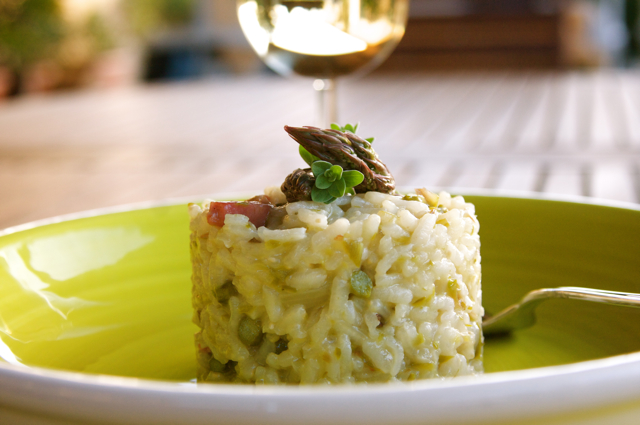
Risotto agli Asparagi (Asparagus)

With the asparagus in abundance this period, I knew that sooner or later I would be cooking risotto agli asparagi. I had been resorting to cooking risotti lately because they are fast & easy to prepare. Kid duties and cooking risotti can be concurrent because the latter part of cooking this dish doesn't need so much attention except a stir here and there coupled with adding the broth.
The big challenge starts when my one-year old eats. She had the sudden decisive moment of going independent in eating. Hooray! She loves eating rice. Sigh. Rice and novice spoon handlers don't go well together. I'm trying to convince her that we don't need to refurbish the kitchen wall & floor yet but she's determined to give it a new look....with rice.
Having only three main ingredients, the quality of each of the ingredients is instrumental in creating a tasty dish. Asparagus has a mild flavour and it relies on another ingredient to perk up the taste which I found in pancetta affumicata. Parmigiano reggiano is almost always present in most risotto dishes and its main role is to make the food taste fuller and rounder.
For the asparagus season, a bowl of this risotto would make a sumptuous meal for the little, medium and big members of the family.
Risotto agli Asparagi (Asparagus)
Ingredients:
Serves 4
- 300 g. Arborio rice or any similar kind
- 250 g. asparagus, tough ends discarded, chopped finely
- 150 g. cubed pancetta affumicata (smoked pancetta)
- 250 ml. or 1 cup white wine
- 1 scallion, chopped finely
- a knob of butter
- 1/3 cup parmigiano reggiano, grated
- 1 liter hot vegetable broth
- salt & pepper
- extra virgin olive oil
- Boil a pot of vegetable broth.
- In another pot, saute' scallion in extra virgin olive oil. When they start to color, add pancetta affumicata. Toast for about 5 minutes or until they start to turn brownish.
- Add asparagus. Toss the ingredients together for about 10 minutes.
4. Add the rice. Toast for 3 minutes.
5. Put the flame higher and add the wine. When the wine evaporates, put the flame down again.
6. Ladle the broth to the risotto little by little and stir frequently so that the rice doesn't stick to the sides. Season with salt & pepper.
7. Turn off fire when you see that the rice is already al dente. Add a knob of butter. Add parmigiano reggiano.
8. Serve hot or warm.
17 April 2011
Foglie d'Ulivo con Spinaci, Pollo & Peperone (Spinach, Chicken & Pepper)
Foglie d'ulivo means olive leaves. This is the first time I saw this type of pasta, my husband included. There's nothing much written about it in the internet which makes me certain that this is not a classic shape. I couldn't even find it in the list of classic & new types of pasta. As far I can find out, it is produced only in some regions of Italy namely Liguria, Campania, Toscana & Puglia. My foglie d'ulivo came from Puglia.
I wanted to cook something without tomatoes this time. As much as my household loves tomatoes, I think we need a break sometimes. I have some fresh red peppers and some chicken fillets I was planning to do roll-ups with. I nicked a few from each and grabbed a small pack of spinach in the fridge. With the three main ingredients available, I chanced upon a simple recipe from Donna Moderna. It's perfect. It's fast, easy and can be on the table before my children notice their hunger pangs. I am not a big planner on what I cook. Aside from not having the extra time to browse around the internet or read the cookbooks for ideas much in advance, my brain only starts whirring when faced with the ingredients in the kitchen.
Chicken and bell peppers have always been partners. Spinach goes with almost anything because it has a very mild taste. I was worried that this pasta would come out insipid, but instead, the blending of the flavours was pleasantly subtle. Both kids ate it with zest, which is the important thing.
I changed a few things in the recipe. I halved the spinach because I didn't have enough, put more white wine, lessened the pasta and chicken and finally, cooked the chicken a few minutes longer. I have a paranoia of undercooked chicken (and pork). I cooked only one pepper but both my husband and I agree that it needs more so I recommend adding another one to the singular pepper the original recipe was asking for.
Foglie d'Ulivo con Spinaci, Pollo & Peperone (Spinach, Chicken & Pepper)
Ingredients:
Serves 4
- 300 g. foglie di ulivo pasta or any pasta
- 250 g. fresh or frozen spinach, chopped coarsely
- 1 scallion or half onion, chopped finely
- 2 medium red bell peppers, seeded & diced
- 200 g. chicken, diced
- bunch of basil, chopped
- 1/2 cup white wine
- extra virgin olive oil
- salt & pepper
- Boil water in a cooking pot for the pasta. When it boils, add salt and follow the number of minutes the pasta should cook.
- Saute' scallion in saucepan with extra virgin olive oil. When it colors, after about a couple of minutes, add bell pepper and chicken. Saute' until pepper becomes tender and chicken starts to toast, about 8 - 10 minutes.
- Add white wine and let evaporate with high flame for a couple of minutes.
4. Add the spinach and cook for another 5 minutes. Season with salt & pepper.
5. Add the basil and the cooked pasta with the chicken. Toss for about a couple of minutes before turning off the fire. Drizzle with extra virgin olive oil before serving.
16 April 2011
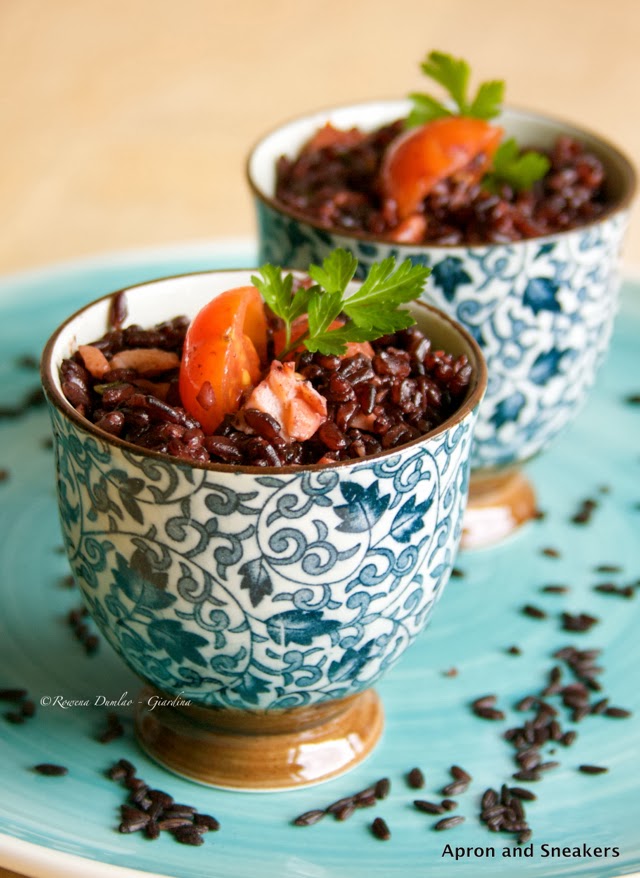
Black Venere Rice with Smoked Salmon
What attracted me to this rice is its color. It's naturally black. I don't really have a certain predilection for black food, I just find them so mysterious and aesthetic especially when combined with red and green. But I won't put any black food in my mouth unless I know what it is or what is in it. Black hides everything and I like to have visual discernment of what I eat.
Since this is the first time I encountered venere rice, I had to get to know more about it. It mystified me why it is naturally black. It has a high vegetal substance content called antocians. Its iron content is four times higher than the normal rice and the selenium is twice higher. This makes it good in anti-ageing and increasing the immune defense system. Oh, yes!
Born in the Po Valley of Italy, it is a cross-breed between an Italian variety and Asian black rice. In China, this kind of rice has existed since 12800 B.C. It was cultivated only for the emperors and their courts until the 19th century because it was rare and the production was scarce. It is still more expensive than the normal rice even in Italy.
I really had no idea how to cook this rice. Luckily, the box came with a suggested recipe. And what do you know, I have all the ingredients on hand. The first thing I noticed about this rice is the smell. It smells so wonderful while cooking! Reading the box again, it did say that it has a characteristic aroma of freshly baked bread. Freshly baked bread is one home aroma I am crazy about. If only I can bottle it and keep it.
Aroma, flavour & appearance. This rice has everything I like in a food. Welcome to my cupboard, venere.
Black Venere Rice with Smoked Salmon
Ingredients:
Serves 4
- 250 g. venere rice
- 10 - 12 cherry tomatoes, quartered or halved
- 100 g. smoked salmon, cubes or strips
- bunch of parsley, chopped
- 1 clove garlic
- 1/2 glass white wine
- salt
- extra virgin olive oil
- Cook rice in a pot with salted water.
- In another saucepan, saute' the garlic clove in extra virgin olive oil (about 3 tablespoons). Discard garlic when it turns brown.
- Add the cherry tomatoes and brown for about a minute.
- Then add the salmon. Add the the white wine and simmer until sauce is reduced.
- Put the cooked rice in the saucepan of the salmon & tomato mixture. Sprinkle with the chopped parsley & salt. Drizzle with extra virgin olive oil.
Pin It
15 April 2011
Roasted Asparagus & Salmon Salad
When these green spears start their public appearance, I am one of the first grabbers in the market. I love asparagus and they have a designated permanency in our annual spring menu. I enjoy eating them steamed, drizzled with extra virgin olive oil and sprinkled with salt. Simple, plain and healthy.
This time, I thought of dressing them up a bit more than the usual steaming. I took out my reliable griddle and roasted them. Then I topped them with fresh tomatoes & chives. I finished the opened packages of smoked salmon & palm heart that have been resting inside my fridge. A sprinkling of salt & poppy seeds then drizzling with balsamic vinegar and extra virgin olive oil completed this delightful spring salad.
Roasted Asparagus & Salmon Salad
Ingredients:
Serves 2
- 250 g. asparagus, tough ends cut
- 8 - 10 cherry tomatoes, halved
- 4 - 5 palm hearts or palmito, cut into round slices
- 2 slices of smoked salmon
- 2 sprigs of chives, chopped finely
- balsamic vinegar
- salt
- extra virgin olive oil
- poppy seeds (optional)
- Cut tough ends of asparagus.
- Drizzle stove top griddle with extra virgin olive oil. Wipe away excess oil with a kitchen paper towel. Sprinkle with salt. When it is already hot, put the asparagus spears. Roast until tender.
- Arrange asparagus on a plate. Add tomatoes, palm heart, salmon & chives. Drizzle with balsamic vinegar and extra virgin olive oil. Sprinkle with salt & poppy seeds.
14 April 2011
Risotto ai Carciofi & Pistacchi (Artichokes & Pistachios)
Lately, I had been fixated in cooking risotti. Whenever I get my hands on some fresh vegetables, they automatically get drowned in wine, rice & hot broth. Maybe because the temperature suddenly crept up that I feel like winter packed up everything in one night and didn't leave any trace of the cold behind that it's just apropos to eat cold and tepid food. Since my husband and I enjoy the risotti better when they are lukewarm, not scalding hot like the pasta dishes, then risotti are perfect to enjoy for the sudden warmth we are experiencing.
When I go out, the spring vegetables are so exhilarating to look at that I get the big desire to go home with crates and crates of everything I see. But I can't. My kids will have a demonstration at home to put a stop to Mommy's vegetable frenzy. For now, I satisfied myself with a bunch of beautiful big artichokes. I used some to cook as side dish to a meat dish and the rest for risotto ai carciofi that I added some pistachios to.
Risotto ai Carciofi & Pistacchi (Artichokes & Pistachios)
Ingredients:
Serves 4
When I go out, the spring vegetables are so exhilarating to look at that I get the big desire to go home with crates and crates of everything I see. But I can't. My kids will have a demonstration at home to put a stop to Mommy's vegetable frenzy. For now, I satisfied myself with a bunch of beautiful big artichokes. I used some to cook as side dish to a meat dish and the rest for risotto ai carciofi that I added some pistachios to.
Risotto ai Carciofi & Pistacchi (Artichokes & Pistachios)
Ingredients:
Serves 4
- 4 big artichokes, chopped into strips
- 250 g. Arborio rice or any similar kind
- 1 garlic, crushed
- 1 scallion, finely chopped
- 1 cup water
- 1/2 cup parmigiano reggiano, grated
- knob of butter
- salt & pepper
- extra virgin olive oil
- 1 liter hot vegetable broth
- 1/2 cup pistachios, chopped coarsely
- 1 lemon
- 250 ml. or 1 cup white wine
- Prepare a deep bowl filled with water. Cut the lemon in half. Squeeze the juice of one-half lemon in the water. Put the squeezed lemon in the water too.
- Clean artichokes by taking away the tough outer leaves. Leave only about 5 cm. of the stem. Rub the cleaned artichoke with the other half of the lemon to avoid discoloration. Put the cleaned artichokes in the lemon water.
- Boil a pot of vegetable broth.
- In another pot, saute' garlic & scallion in extra virgin olive oil. When they start to color, add artichokes. Toast for about 3 minutes then add a cup of water. Cover and simmer until water is reduced to a tenth of its original volume, about 10 - 15 minutes. Discard garlic.
- Add the rice. Toast for 3 minutes.
- Put the flame higher and add the wine. When the wine evaporates, put the flame down again.
- Ladle the broth to the risotto little by little and stir frequently so that the rice doesn't stick to the sides.
- Add the pistachios halfway through cooking.
- Turn off fire when you see that the rice is already al dente. Add a knob of butter. Add parmigiano reggiano.
- Serve hot or warm.
Labels:
italian,
rice,
risotto,
vegetables
13 April 2011
Buckwheat, Quinoa & Rice Salad with Clementine, Tuna & Tomatoes
Pseudocereal (so͞oˈdō-sîrˌē-əl) n. Any of several plants, that do not belong to the grass family but produce fruit and seeds used as flour for bread and other staples.
I never encountered this word before until I bought some quinoa and buckwheat from the world market. Both are very nutritious and gluten free. I'm still finding out different ways to cook the quinoa and there seems to be a vast world behind this ancient pseudocereal from South America. On the other hand, I am familiar with buckwheat because I like torta di grano saraceno or buckwheat cake which is one of the typical cakes of Alto Aldige in northern Italy.
Pin It
Labels:
buckwheat,
cereals,
clementines,
quinoa,
rice,
rice salad,
salad,
tomatoes,
tuna
12 April 2011
Spaghetti con Ragu' alla Bolognese (Tomato Meat Sauce)
Pasta con
ragu' is my Italian comfort food. After splurging on different
contemporary dishes, it's a relief to go back to basic and taste this
familiar tomato and meat sauce sprinkled with a torrential amount of
parmigiano reggiano. Ragu'
is the tomato and meat sauce popularized worldwide with the name
bolognese. It's actually ragu' alla bolognese. Bolognese signifies
that it comes from Bologna, Italy.
10 April 2011
Classic Tiramisu'
When I was younger, I never thought the name tiramisu' has a meaning.
It literally means pick me up. And it does pick you up with the
ingredients in it. I like tiramisu' but I rarely order it in the
restaurants because it gets overshadowed by other cakes that seize my
attention. It's always present among the desserts of the restaurants
that it seems that the printing of menus has tiramisu' already
pre-printed in it because almost every restaurant has it.
Pin It
Labels:
dessert,
italian,
marsala,
mascarpone,
tiramisu
09 April 2011
Prosciutto Crudo Roll with Gorgonzola and Pear
If you are in a rush and have no idea what to prepare for starters, grab these three ingredients and roll away. It takes very little time and effort and you can come up with some presentable and sumptuous rolls. I guess gorgonzola has a peculiarity that some tiptoe around whether to eat it or not. Blue cheese is blue cheese, wherever it comes from.
Labels:
antipasto,
appetizer,
finger food,
gorgonzola,
pears,
prosciutto
08 April 2011
Spaghetti con le Vongole
If a promise of eating ice cream to a child works its wonders, this pasta dish does to mine. For a child of five, it is a tad strange to latch on to this dish as a topnatcher favorite. In fact, I recently cooked this as a desperate move to supress an erupting tantrum.
Spaghetti con le vongole is a Neapolitan pasta dish by origin but widely diffused all over Italy as it is a classic seafood pasta favorite. If you are in a seafood restaurant, you will most likely find this in the menu. There are two variants, one with fresh tomatoes and the other without. There are also some with zucchini. At home, I always cook the white one. If you want your pasta with tomatoes, just add a few pieces of halved cherry tomatoes. The cooking procedure is exactly the same.
There are two kinds of vongole that are sold in Italy. The vongole veraci (Ruditapes decussatus) or carpet shell clams and vongole filippine (Tapes philippinarum) or Philippine clams, introduced in the waters of Venice in the 80's but the vongole veraci are more widely used because they are tastier and more tender.
Because there is a limited number of ingredients in this dish, every ingredient is essential in contributing its unique taste. Being married to a person who despises garlic, I have learned to tone down my garlic usage in cooking. This specific dish though is exempted from my usual limited garlic rule. After some trials & errors, I have learned that the garlic is actually fundamental in boosting the taste of the vongole. So I finally had the garlic binge I thought I would never have again. I quadrupled my habitual singular garlic and I finally got the perfect taste I was looking for.
Spaghetti con le Vongole
Ingredients:
Serves 4
- 350 g. spaghetti
- 1 kilo vongole veraci (ruditapes decussatus) or carpet shell clams, purged of sand
- 1 cup or 250 ml. white wine
- bunch of fresh parsley
- 4 garlic cloves
- 1 dried chili
- Boil water for the spaghetti in a pot. Follow the package intructions in cooking the pasta. The sauce should cook prior to the spaghetti.
- In a saucepan, saute' halved garlic & chili. When it starts to color, move the pan away from the fire for a few seconds. Add the vongole and mix. Do this to avoid the spatters of oil all over the stove, Put back in the fire and cook until they all open. Discard the ones that didn't open if there are any.
- Cook until the natural water of vongole is reduced. Pour the wine. Maintain a medium-high fire until the alcohol has completely evaporated. Return fire to low-medium.
- Add half of the chopped parsley.
- Simmer until the sauce is reduced and has become denser.
- Don't add salt because the clams are already salty.
- Mix cooked pasta over low fire.
- Drizzle with extra virgin olive oil & sprinkle the rest of the parsley.
Pin It
Subscribe to:
Posts (Atom)